

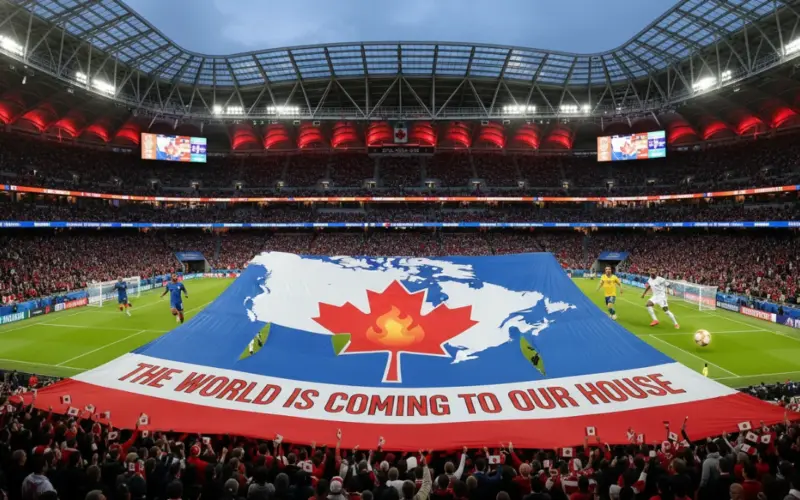
The 2026 FIFA World Cup will put Canada, Mexico, and the United States at the center of the sport, and the field of favorites is already taking shape. With the tournament’s expanded format and the pressure of North American travel, the race for the title should be tighter and stranger than ever.
For Canadian fans, the dream is simple: support Les Rouges and hope for a breakout run on home soil. But the bigger storyline is which global powers arrive ready to handle the scale, the pace, and the spotlight of this event.
The Short List
Here is a straightforward ranking of the 10 sides most likely to contend for the trophy, based on current squad quality, tournament experience, and match-winning depth.
- France remains the standard. Its roster is stacked from back to front, and Kylian Mbappé gives the team the kind of game-breaking threat that changes every matchup. France has the depth, speed, and big-game calm to stay dangerous throughout the tournament.
- Brazil brings elite attacking talent and enough structure to support it. Vinícius Júnior and Rodrygo can turn open space into goals fast, and Brazil’s ability to mix flair with discipline makes it a serious title threat.
- England has one of the most balanced groups in the competition. Jude Bellingham controls the middle, Harry Kane still finishes chances at an elite rate, and the only real question is whether the team can absorb the weight of expectation.
- Argentina enters as the defending champion and still knows how to win when the match gets messy. Lionel Messi may no longer carry every attack, but the team around him has matured into a hard-edged, well-connected unit.
- Spain has moved into a faster, sharper version of its old identity. With Lamine Yamal and other young creators driving the attack, Spain can keep the ball, break lines, and punish teams that get too passive.
- Germany looks rebuilt after a difficult stretch. Its best version is organized, efficient, and relentless, and that profile usually holds up well in long tournaments.
- Portugal is deeper and less dependent on one star than in the past. Rafael Leão, Bruno Fernandes, and Bernardo Silva give it creativity and tempo, which is exactly what a knockout team needs.
- Italy may not be the flashiest side in the field, but it is built for survival. Strong defending, disciplined spacing, and careful game management still matter when margins get small.
- Netherlands has the defensive structure to frustrate anyone. If the attack produces enough goals to match that stability, the Dutch can make a deep run.
- Uruguay is the wild card nobody wants early in the bracket. Under Marcelo Bielsa, it plays fast, aggressive, and relentless, which can overwhelm more polished teams if the press lands early.
Why These Teams Stand Out
The common thread is depth. In a 48-team World Cup, the path to the title will be longer, and the best squads will need more than one or two stars. France and Brazil stand out because they can absorb injuries, manage rotation, and still threaten every opponent. England and Argentina follow closely because they combine elite talent with enough structure to survive pressure-filled matches.
Spain, Germany, and Portugal sit just below that top tier, but each has a realistic route to the final if the bracket opens up. Spain’s technical quality, Germany’s organization, and Portugal’s attacking versatility all translate well in tournament play. Italy, the Netherlands, and Uruguay round out the list because their styles are built for knockout football, where control, resilience, and physical intensity matter as much as raw talent.
Canada’s Realistic Path
Canada will not enter as a favorite, but home support changes the equation. Alphonso Davies gives the team elite speed and direct threat, and a loud crowd in Toronto or Vancouver can make every group-stage match feel heavier for the opponent.
If Canada wants to surprise people, it will need to stay compact, move quickly in transition, and make its moments count. That is a demanding formula, but in a tournament this large, one strong stretch can change everything.
That is what makes 2026 compelling: the giants are still the giants, but the margins are thinner, the travel is tougher, and the atmosphere will be unlike anything the World Cup has seen before.