
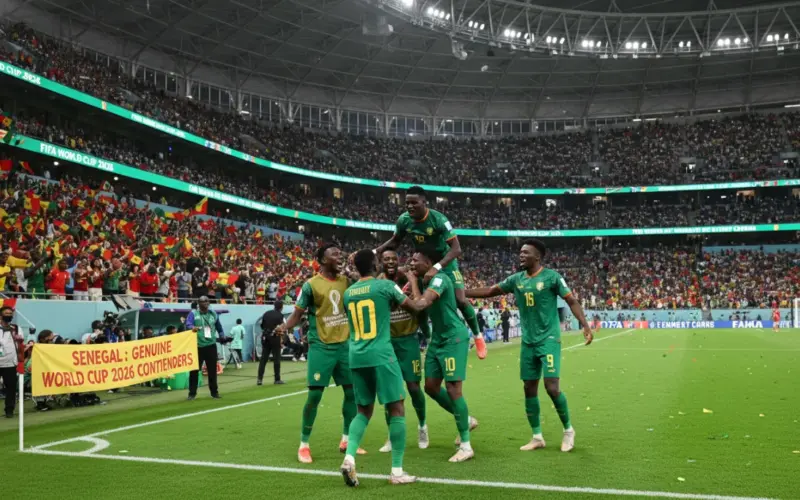
Senegal enters the 2026 World Cup conversation with real ambition, not polite hope. Head coach Pape Thiaw has made that clear, and the country’s recent progress gives his confidence more weight than bravado.
For years, Senegal was viewed as a dangerous African side with flashes of quality. That label no longer fits. The Lions of Teranga now carry themselves like a team that expects to compete deep into the tournament, and their mix of proven veterans and fast-rising young players makes them one of the most intriguing contenders outside the traditional powers. For fans tracking the tournament from a betting angle, the Senegal World Cup 2026 prospects have become a serious talking point, and Canadians can wager on Senegal for the World Cup on Rexbet Canada through a team profile that blends pedigree, depth, and upside.

But Senegal’s rise is not a simple success story. The same system that keeps producing international-level talent also exposes a deeper imbalance. The national team benefits enormously, yet the domestic game often absorbs the cost.
A Talent Factory Built on Uneven Ground
Senegal’s football output is remarkable for a country of about 20 million people. It regularly produces elite players at a rate that rivals much larger nations, and much of that pipeline comes from academies such as Generation Foot, Diambars, and Dakar Sacre Coeur.
These academies do more than train footballers. They provide schooling, healthcare, and professional coaching, while also serving as direct routes into Europe’s biggest leagues. In practice, they have become some of the most efficient talent bridges in African football.
The problem is that the money flow is far from balanced. Many of these academies are locked into long-term arrangements with European clubs, which secure first access to the best prospects. FC Metz’s long partnership with Generation Foot is the best-known example, and it helped produce names such as Sadio Mane, Ismaila Sarr, and Pape Matar Sarr.
Even so, the financial return to Senegal is tiny compared with the value created abroad. One review of 13 academy-developed players selected for Senegal’s continental squads found that those players brought their local academies only €100,000 in initial transfer fees, while European clubs later sold them for a combined €81.2 million. Across their careers, those same players have generated more than €411 million in transfer fees.
That gap explains the contradiction at the heart of Senegalese football. Foreign clubs profit from a system that refines local talent, while many domestic teams continue to struggle with weak infrastructure, poor stadium conditions, and limited league visibility. Even when FIFA solidarity payments are due, local clubs have sometimes had to fight for money they are already owed, including cases tied to major transfers such as Nicolas Jackson’s move to Chelsea.
Why the Diaspora Strategy Works
Senegal has also become highly effective at securing players from its diaspora before they commit to another national program. In earlier years, the country often lost dual-national prospects to stronger European systems. That trend has shifted.
Today, the federation moves early, especially with players between 16 and 19 who are developing in Western Europe. The approach combines identity, family ties, and sporting opportunity. For many of these players, the connection to Senegal remains strong inside the home, even if they were raised elsewhere.
That strategy has already paid off with additions such as Ibrahim Mbaye of PSG and Mamadou Sarr of Chelsea, both of whom previously represented France at youth level. These are not symbolic pickups; they are players with top-level pathways and the athletic profile to strengthen Senegal for years.
2026 Could Define an Era
The current squad has unusual range. A veteran like Idrissa Gana Gueye can line up alongside teenage prospects, giving Senegal a blend of experience and pace that few teams can match.
For the core of the golden generation, this World Cup may be the last chance to leave a lasting global mark. Sadio Mane, Kalidou Koulibaly, and Edouard Mendy have already shaped Senegal’s modern identity, but 2026 may be their final shot at turning that progress into a truly historic run.
The group stage will be demanding. Senegal sits in Group I with France, Norway, and Iraq, and the opener against France in New Jersey is likely to reveal how far this team can really go. If Senegal survives that test, its tactical discipline, physical power, and squad depth could make it dangerous in the knockout rounds. The bigger question is not whether Senegal has talent. It does. The question is whether the system that built it can also protect and sustain it.