

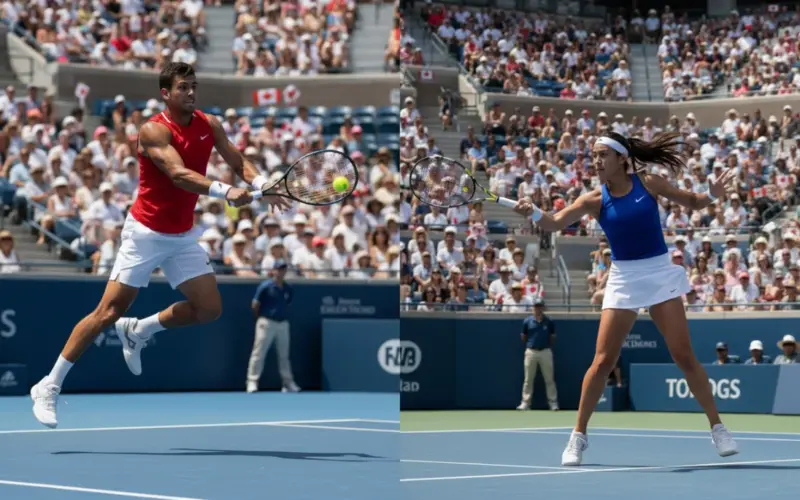
The round of 16 at the 2026 National Bank Open arrives with two very different storylines: a chaotic men’s event in Montreal and a steadier women’s draw in Toronto. By the end of the weekend, eight players in each bracket will be left standing.
Saturday, August 8, and Sunday, August 9, will determine who reaches the quarterfinals, and the matchups already feel pivotal. Some of the sport’s biggest names are gone on the men’s side, while the women’s field still has several of the tour’s most reliable title threats.
What the Weekend Schedule Looks Like
The round-of-16 matches are spread across two days, with Montreal and Toronto each running full center-court sessions. In Montreal, the day session begins at 12:30 p.m. and the evening session starts at 6 p.m.
Toronto follows a similar rhythm, with daytime action starting at 12:30 p.m. and night matches beginning at 7 p.m. The order of play is usually finalized close to match day, since weather, court length, and prior results can shift the timing.
Each city will stage eight singles matches over the weekend, and the winners will move into the quarterfinals on Monday, August 10, and Tuesday, August 11.
Montreal’s Men’s Draw Has Opened Up Fast
Few people expected the men’s bracket to look this unsettled so quickly. Alexander Zverev, Daniil Medvedev, Taylor Fritz, and Andrey Rublev were all knocked out in their first matches, and Félix Auger-Aliassime withdrew before he could begin because of a back injury. That left the tournament without six of its top 10 seeds before the second round was even complete.
The result is one of those rare Masters 1000 draws where almost anyone left in the field can sense an opportunity. Ben Shelton, the defending champion, still looks like the most obvious favorite after opening with a 6-3, 7-5 win over Jenson Brooksby. His serve is a major weapon on Montreal’s faster courts, and his high-tempo style can overwhelm opponents before they settle in.
Casper Ruud also enters the week with real momentum after a comfortable 6-1, 6-2 victory over Juan Manuel Cerúndolo. Ruud has long been associated with clay-court success, but his hard-court results have steadily improved enough to make him a legitimate threat in a draw that has already lost so many established names.
Three Matches and Trends to Watch in Montreal
- Ben Shelton’s title defense now feels more manageable on paper, but the burden has changed. He is no longer the young player trying to surprise the field; he is the reigning champion everyone now expects to beat. If he keeps his first-strike tennis under control, he has a real route back to the final.
- João Fonseca has already shown why he is becoming one of the most talked-about young players on tour. His win over Stefanos Tsitsipas was one of the week’s early statement results, and it reinforced the sense that his power game travels well in big stadium settings.
- Arthur Fils and Tallon Griekspoor are also benefiting from the chaos. Fils handled Zachary Svajda in three sets, while Griekspoor outlasted Zverev after dropping the opening set. In a draw this open, one breakthrough can change the entire mood of a tournament run.
Those names matter because Montreal has quickly shifted from a tournament of established stars to a field shaped by confidence, timing, and the ability to handle pressure after an upset. That kind of environment often rewards players who stay aggressive without becoming reckless.
Canada’s Men Miss the Late Rounds
Home support was supposed to center on Auger-Aliassime and Gabriel Diallo, but the week did not unfold that way. Auger-Aliassime never made it onto the court, and Diallo’s run ended when he retired against Luciano Darderi after making a promising start with a first-round win over Kyrian Jacquet.
That means no Canadian man reached the round of 16 in Montreal, a disappointing outcome for local fans who wanted a deeper run at home. Even so, the stadium will still have plenty of star power to follow, especially with Shelton, Ruud, Fonseca, Fils, and Griekspoor still in contention.
Toronto’s Women Bring More Predictability
The women’s draw has been more stable, and the marquee names have mostly advanced the way many expected. Aryna Sabalenka, Elena Rybakina, Jessica Pegula, Coco Gauff, and Mirra Andreeva all moved through their opening matches and remain central figures in the title conversation.
Sabalenka is still the player everyone is trying to chase. The world No. 1 beat Moyuka Uchijima 6-3, 6-3 and extended her hard-court winning streak to 13 matches. Her serve and ball-striking fit Toronto’s quick conditions, and another deep run would reinforce her position at the top of the rankings.
Rybakina, meanwhile, had to work harder to earn her place in the next round. She defeated Daria Kasatkina 6-3, 5-7, 6-4 in two hours and 33 minutes, finishing with 58 winners and 58 unforced errors. That line captures the dual nature of her game: when she is clean and aggressive, she can dominate almost anyone, but the margin for error can disappear quickly.
The Biggest Threats in the Women’s Field
Coco Gauff opened with a 6-2, 7-5 win over qualifier Kayla Day. She did not dictate every rally, but her movement and defensive range helped her win the key points when the match tightened. That ability to absorb pressure is often what separates her from more one-dimensional opponents.
Jessica Pegula needed a longer comeback to get through her first match. After losing the opening set to Magdalena Frech, she regrouped and finished strongly for a 3-6, 6-3, 6-1 victory. Pegula has already won this event twice, in 2023 and 2024, so she enters the week with both confidence and a proven understanding of the conditions.
Mirra Andreeva may have produced the most eye-catching result of the group. She dismissed former world No. 1 Karolina Pliskova 6-0, 6-2 in just 54 minutes, showing a level of composure that is unusual for a 19-year-old. Her ability to vary pace, defend with patience, and avoid unnecessary errors makes her especially dangerous on a surface where quick adjustments matter.
Leylah Fernandez Carries the Remaining Canadian Hope
Leylah Fernandez is now the last Canadian left in either singles draw after a clear 6-2, 6-2 win over Renata Zarazúa. Playing in front of a center-court crowd, she controlled the match well, lost serve only once, and broke her opponent five times.
Her next challenge comes against Elise Mertens, a seasoned competitor who can extend rallies and force uncomfortable decisions. Fernandez will need to keep taking the ball early and creating offense with her forehand if she wants to keep the Canadian run alive.
That expectation adds pressure, but it also reflects what makes Fernandez dangerous when she is confident. She does not need perfect conditions to compete, only enough rhythm to dictate the shape of the point before her opponent does.
How to Follow the Action
- Watch the Saturday and Sunday sessions in Montreal and Toronto to see which favorites hold position and which underdogs keep the draw unsettled.
- Track Shelton, Ruud, Fonseca, Fils, and Griekspoor in Montreal, where the men’s bracket has already become a test of nerve as much as talent.
- Follow Sabalenka, Rybakina, Pegula, Gauff, Andreeva, and Fernandez in Toronto, where the women’s field still features several realistic championship paths.
- Check the official order of play before each session, since match length and scheduling changes can affect when players actually step on court.
Sportsnet and TVA Sports are carrying coverage from both cities throughout the tournament, with additional viewing available through their digital platforms. Because the weekend should reshape both draws in a major way, the round of 16 may end up defining the entire tone of the 2026 National Bank Open.