
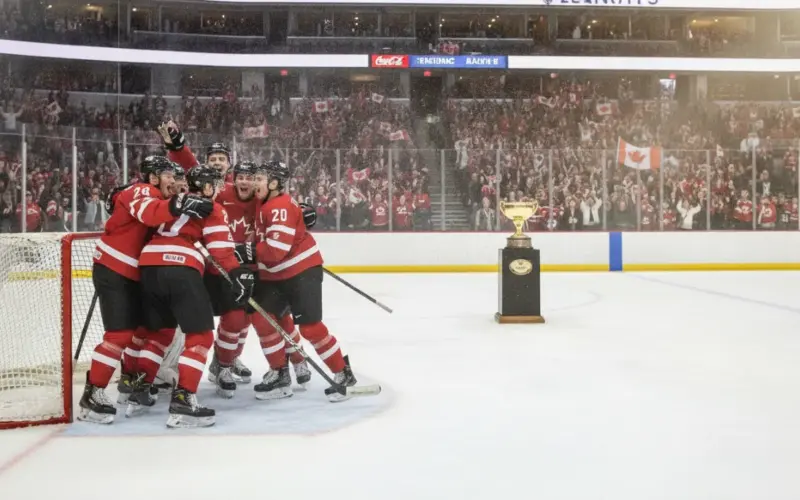
Canada is one win from the 2026 Hlinka Gretzky Cup final after a flawless preliminary round in Edmonton. The host team now meets Finland in Friday’s semifinal, with a possible championship clash against the United States or Slovakia waiting on the other side.
The Canadians have looked sharp from the start. They scored 20 goals across three games, finished first in Group A, and showed enough depth to remain one of the tournament’s top title threats.
Semifinal Time and Site
Canada and Finland will play on Friday, August 7, 2026 at Rogers Place in Edmonton. The puck drops at 5 p.m. Mountain Time, which is 7 p.m. Eastern Time, 4 p.m. Pacific Time, 8 p.m. Atlantic Time, and 8:30 p.m. Newfoundland Time.
The winner advances to Saturday’s gold medal game, while the loser drops into the bronze medal match. TSN and RDS are carrying the games from Rogers Place.
How the Medal Round Is Shaped
The other semifinal features the United States and Slovakia on Friday at noon Mountain Time. That matchup decides Canada’s potential opponent in the title game.
A Canada-United States final would feature two unbeaten preliminary-round teams. The Americans went 3-0 in Group B, beat Czechia, Finland, and Germany, and allowed only six goals while scoring 18.
A meeting with Slovakia would carry a different storyline. Canada already beat Slovakia 6-1 in the preliminary round, but Slovakia still enters the medal round with one of the tournament’s most dangerous scorers in Tomas Selic, who led all players with eight points after the group stage.
Canada’s Route to This Point
Canada opened with a 7-3 win over Switzerland, then followed with a 6-1 result against Slovakia. It finished the sweep by beating Sweden 7-4 on Wednesday.
That last game showed both Canada’s firepower and its occasional looseness. The hosts built a big lead early, finished with 49 shots, and then had to answer back when Sweden pushed in the middle and late stages.
The preliminary round numbers tell the story clearly. Canada went 3-0, scored 20 goals, allowed eight, and took first place in Group A. That earned the semifinal matchup with Finland, which placed second in Group B behind the United States.
| Team | Record | Goals For | Goals Against | Group Finish |
|---|---|---|---|---|
| Canada | 3-0 | 20 | 8 | 1st in Group A |
| Finland | 2-1 | 10 | 10 | 2nd in Group B |
| United States | 3-0 | 18 | 6 | 1st in Group B |
| Slovakia | 1-2 | 10 | 10 | 3rd in Group B |
What Finland Brings Into the Match
Finland reached the semifinal by winning two of three games. It rallied past Germany 5-2 in its opener, lost 4-1 to the United States, and edged Czechia 5-4 in a tense final group game.
Goaltender Samu Heikkinen is a major reason Finland is still alive. He stopped 38 shots against Czechia and entered the semifinal with a .922 save percentage, one of the best marks among tournament goalies after the preliminary round.
Canada should control possession more often, but Finland has already proved it can stay patient and survive under pressure. If Heikkinen settles in early, Canada will need to create traffic, second chances, and cleaner looks from close range rather than relying on perimeter shots.
Canadian Players Worth Watching
Maddox Schultz
Schultz has been Canada’s most productive playmaker so far. The Regina Pats forward posted one goal and six assists in the preliminary round, giving him seven points and second place in the tournament scoring race behind Selic.
His value goes beyond the totals. Schultz has been creating space, feeding teammates in stride, and keeping Canada’s attack moving with constant puck support.
Liam Pue
Pue leads Canada in goals after scoring four times and adding two assists in three games. He scored twice against Switzerland and added another in the win over Sweden.
His finishing touch matters because Canada is likely to generate volume again. Turning chances into goals will be the difference between a strong effort and a place in the final.
Kayden Stroeder
Stroeder has been one of Canada’s most reliable forwards. He finished the group stage with three goals and three assists, including two goals against Slovakia and a strong all-around game against Sweden.
He brings pace, versatility, and the ability to score in different situations, which makes him a useful weapon in a tight knockout game.
Landon DuPont
DuPont has drawn attention throughout the tournament, and for good reason. The Everett Silvertips defenseman produced one goal and two assists in the preliminary round while helping Canada move the puck quickly out of its own end.
He also arrives with prior tournament experience, having won bronze at the 2025 Hlinka Gretzky Cup. That background could matter in a semifinal where calm decisions are essential.
Leif Oaten
Oaten has not had to face a massive workload, but he may be asked for timely stops if the semifinal tightens. He posted a 2.50 goals-against average in the group stage.
Finland may not fire as often as Canada, but its counterattacks and special teams can still create pressure. Oaten’s composure could help if the game turns into a one-goal battle.
Why Canada Still Looks Dangerous
Canada’s biggest edge is spread-out offense. Four players finished the preliminary round among the tournament’s top seven scorers: Schultz with seven points, Pue with six, Stroeder with six, and Ryerson Edgar with five.
The scoring has not come from one line alone. DuPont, Jaakko Wycisk, Brock Cripps, and Alexis Joseph have all chipped in from the back end, which makes the attack harder to key on and gives Canada more ways to punish mistakes.
That depth matters in a short tournament. Finland can try to slow one line, but stopping the full Canadian lineup for three periods is a much tougher task.
What Canada Must Clean Up
Discipline is the first item on Canada’s checklist. Sweden found some life in the final group game after Canada had already built a 5-0 lead, and penalties helped open the door for that comeback push.
Canada also has to protect the puck in the neutral zone. Finland is built to wait for turnovers and move quickly the other way, so careless exits or forced passes could create problems fast.
Finally, Canada needs patience in the offensive zone. Heikkinen has already shown he can handle a heavy shot load, so the hosts must make life harder with screens, rebounds, and net-front pressure.
Canada has done the hard part of the tournament so far, but the bracket gets tighter now. One more win sends the hosts into Saturday’s final, where the chance at a record-extending 26th summer under-18 gold medal would be on the line.