

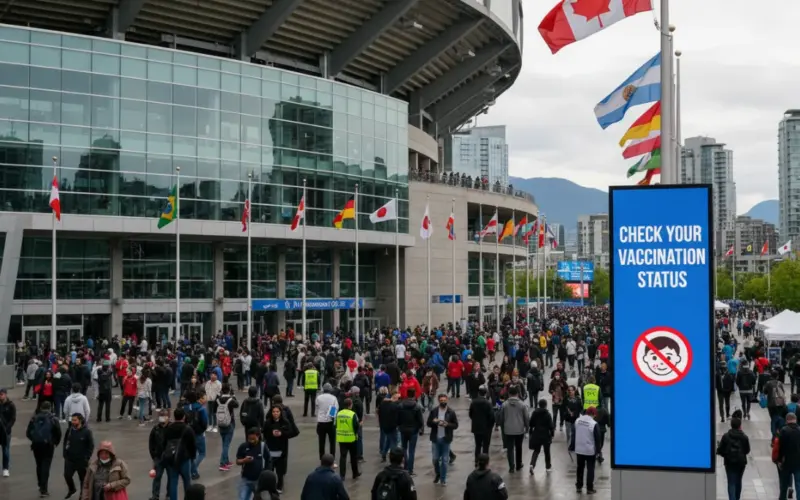
Health officials are warning that the upcoming FIFA World Cup could create new opportunities for measles to spread in Canada, especially in Vancouver, where thousands of international visitors are expected to gather.
The Public Health Agency of Canada has flagged measles as a likely import during the tournament. That concern is based on three simple facts: the virus is still circulating in many countries, it spreads through the air with ease, and major sports events bring large, mixed crowds into close contact.
Ontario has already released a formal infectious disease risk assessment for the World Cup. Its findings point to travel, crowded venues, and falling vaccination coverage as conditions that can make measles harder to contain. British Columbia has not yet made its own public assessment available.
Why B.C. Officials Are Being Asked to Speak Up
Dr. Brian Conway, medical director of the Vancouver Infectious Diseases Centre, says the lack of clear public messaging in British Columbia is a concern.
He believes residents and visitors should be reminded now, before the first wave of fans arrives, to check whether they are protected against measles. If they are not fully immunized, he says, they should get up to date as soon as possible.
Conway also wants travelers to understand that Canada is still dealing with active measles transmission. In his view, the key issue is preparation. Large events are easiest to manage when the public understands the risk early.
The National Picture Remains Unsettled
Canada has already recorded more than 900 measles cases across seven jurisdictions this year, with Alberta and Manitoba reporting the largest totals. The country is still dealing with the effects of a major outbreak that struck last year, when more than 5,000 people became ill.
That earlier surge is believed to have begun in New Brunswick in the fall of 2024 after an exposed traveler returned from outside Canada. Once measles starts moving through communities with uneven vaccination coverage, it can spread fast and widely.
In British Columbia, provincial reporting shows 470 cases across 2025 and 2026. Roughly 80 percent were found in northeastern B.C., where immunization rates are among the lowest in the province.
| Location | Reported pattern | Main concern |
|---|---|---|
| Canada overall | More than 900 cases this year | Imported infections during major gatherings |
| British Columbia | 470 cases in 2025 and 2026 | Clusters in lower-immunization regions |
| Northeastern B.C. | About 80 percent of B.C. cases | Higher chance of local spread if exposure occurs |
A Familiar Lesson From Vancouver’s Olympic History
Public health experts say Vancouver has seen this kind of risk before. After the 2010 Winter Olympics, British Columbia recorded a measles outbreak with 82 confirmed cases. The situation was not identical to today’s World Cup preparations, but it offered an important warning about what can happen when international travel and dense crowds overlap.
Conway says the current environment may be more challenging because measles vaccination rates have slipped in parts of the province. He also notes that some countries sending players, staff, and fans to the World Cup may have even lower coverage, which raises the odds that an infected traveler could arrive during the tournament.
What Local Health Authorities Say They Are Ready For
Vancouver Coastal Health says planning for the World Cup has been underway for years. The authority says it completed a public health risk assessment with the B.C. Centre for Disease Control, although the details have not been released to the public.
Dr. Mark Lysyshyn, deputy chief medical health officer with Vancouver Coastal Health, said the assessment placed the measles risk in the medium, or moderate, range. He said the region has already managed dozens of imported measles cases during the current outbreak without seeing ongoing local transmission.
In his view, strong immunization rates in the Vancouver Coastal Health region have helped stop cases from spreading further. Because of that, he does not expect a single imported case during the World Cup to become unusually difficult to handle.
City Planning Is Also in Place
The City of Vancouver says it has operational and emergency management plans ready for the event. Officials say they are prepared to respond if any public health or safety issue develops during the tournament.
Who Faces the Greatest Risk
Dr. Monika Naus, a professor at the University of British Columbia’s School of Population and Public Health, says large international events always carry some infection risk. Even so, she says the threat to the general public is limited because most adults already have measles immunity through vaccination or previous infection.
The greater concern, she says, is what happens if the virus reaches communities where vaccination coverage is low. In British Columbia, those communities are often clustered geographically, which can allow measles to spread quickly once it gets a foothold.
That is why officials are focusing on prevention rather than reaction. The more people who are protected before the first crowds arrive, the easier it will be to keep an imported case from turning into a larger outbreak.
Why Vaccination Checks Matter Now
Canada lost its measles elimination status after the Pan American Health Organization was notified that transmission had continued for too long. A country loses that status when measles is no longer limited to isolated imported cases and instead keeps spreading over an extended period.
The good news is that elimination status can be regained if transmission is interrupted for a full year. Until then, public health experts say the priority is to reduce avoidable exposure, especially around events that will draw visitors from many parts of the world.
For Vancouver, the message is practical and direct: check your vaccination record, update it if needed, and do not assume the risk is low just because the event is temporary. Measles is highly contagious, but it is also preventable. That makes preparation the most important defense before the World Cup begins.