

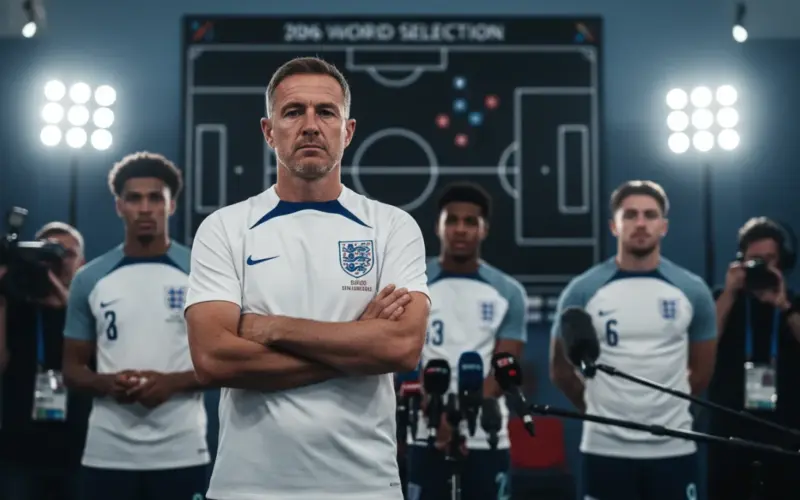
When Thomas Tuchel finalized his England group for the 2026 World Cup, the biggest surprise was not the talent he left out, but the veteran he kept in. Jordan Henderson, now 35 and short on recent club minutes, made the cut while younger, more fashionable midfield names watched from home. That decision immediately raised a fair question: is this a nostalgic nod to a trusted servant, or a deliberate piece of tournament planning?
The answer appears to be a little of both, but mostly the second. Tuchel’s selection suggests he values a squad that can stay organized, stay calm, and stay connected under pressure. In that kind of environment, Henderson is less a luxury and more a stabilizing force.
Why the midfield debate was so crowded
England’s midfield picture was always going to be crowded. Declan Rice and Jude Bellingham seemed locked in long before the final squad was announced, and Elliot Anderson forced his way into the conversation with relentless energy and a pace of play that fit Tuchel’s demand for intensity. Behind them, a second wave of options pressed for recognition, including Morgan Rogers, Eberechi Eze, Kobbie Mainoo, Cole Palmer, Phil Foden, Adam Wharton, and Morgan Gibbs-White.
That depth made every decision feel painful. Some players could dribble through pressure. Others could create a moment from nothing. A few offered control, vision, or final-third quality that could change a game in one action. Henderson, by contrast, did not arrive carrying the same obvious headline value. He had not been producing weekly highlight-reel performances, and his Brentford involvement had been limited by injuries and rotation. By a simple form-and-minutes argument, he was a difficult pick to defend.
| Player Type | Primary Strength | Selection Case |
|---|---|---|
| Rice | Ball winning and balance | Reliable starter and defensive anchor |
| Bellingham | All-action impact | Box-to-box power and decisive quality |
| Anderson | Tempo and energy | High-intensity control in midfield |
| Henderson | Leadership and structure | Experience, communication, and tactical discipline |
The real reason Henderson stayed
Henderson’s value is not built on raw creativity or dominant physical numbers. It rests on the less glamorous traits that matter deeply in a month-long tournament. He organizes teammates, keeps standards high, and gives a manager a trusted voice in moments when a squad can drift. For Tuchel, that matters because the England group is packed with players who are either young, still learning major-tournament pressure, or expected to carry huge attacking responsibility.
There is also the symbolism of his inclusion. Henderson turns 36 on the same day England begin their campaign against Croatia, and that timing opens the possibility of a remarkable milestone: appearances at seven different major tournaments and a fourth World Cup. Even if that history does not decide matches on its own, it reinforces why a coach might want him around. A player who has lived through elite pressure repeatedly can help others handle the emotional swing of knockout football.
Tuchel’s decision also hints at how he sees tournament squads functioning. He does not appear interested in filling every slot with the most exciting individual talent. Instead, he is shaping a group that can survive awkward phases, settle games after a bad stretch, and maintain a clear collective identity. Henderson fits that profile more cleanly than a more expressive but less dependable alternative might.
What Henderson actually brings on the field
On the pitch, Henderson’s game is subtle, but it is not passive. At Brentford, his role has been more about supporting structure than starring in the final action. He drops toward the ball to help the team escape pressure, helps circulate possession, and makes intelligent off-ball runs that create passing lanes for teammates. Those details may not dominate a television broadcast, but they shape how smoothly a team can build.
That movement pattern is important because England will not always be allowed the luxury of slow, comfortable buildup. In tight international matches, the first pass out of pressure can decide whether a team attacks or simply survives. Henderson gives England a player who can help solve that problem repeatedly. He is comfortable showing for the ball, turning defensive moments into controlled possession, and then moving the ball onward before the opposition can lock in.
A useful example came against Manchester United. Henderson drifted into a pocket to receive from Sepp van den Berg, which pulled pressure away from the center of the field and let Yehor Yarmolyuk and Mikkel Damsgaard advance. Henderson then carried the responsibility himself and released a line-breaking pass into Damsgaard. It was not flashy, but it was intelligent, efficient, and exactly the kind of sequence that can steady an international side.
He has also shown the ability to read pressure early. Against Newcastle, he sprinted into a support position for Yarmolyuk, recognized the press before it fully arrived, and played a first-time pass around the corner to beat two opponents in one touch. That kind of quick decision making does not always draw praise, yet it can be invaluable when a team is pinned back and needs a reliable escape route.
Even when England have limited space in behind, Henderson can still contribute vertically. He has already produced assists this season by spotting broken defensive shape, collecting the loose ball, and lofting direct passes into advanced runners. In a tournament where margins are thin, that ability to turn a half-chance into forward momentum may matter more than a more decorative style of midfield play.
How he fits the wider squad puzzle
The other part of Henderson’s case is positional. England’s midfield has a lot of talent, but it does not have a perfect overlap of specialist roles. According to player-role modeling based on Opta and SkillCorner data, Tuchel’s midfield options spread across several different profiles, from dynamic carriers to tempo managers to deep-lying organizers. Henderson stands out because he occupies a specific lane that none of the others quite duplicate.
He is essentially a channel-ball progressor, someone who can help the team move from deeper areas into more advanced positions without forcing the issue. That gives England a different texture in games where Rice might be asked to hold, Bellingham might surge forward, and Anderson might drive the pace. Henderson provides a calm, passing-based bridge between those functions.
Still, his selection is not a verdict that he is better than the omitted names. Palmer and Foden would have offered more pure creativity. Wharton might have supplied a cleaner passing rhythm from a deeper base. Gibbs-White and Mainoo could have added other forms of control or threat. Henderson’s advantage is narrower, but it is real: he is trusted to do a very particular job without losing his shape or his nerve.
The final judgment
Henderson’s inclusion will always divide opinion because it asks people to value reliability over sparkle. That can feel conservative, especially when several younger players appear more exciting on paper. But tournament football is rarely won by paper alone. It is won by teams that know who they are, by dressing rooms that stay connected, and by players who understand how to manage difficult moments without panic.
That is why Tuchel’s surprise call makes sense. Henderson may not be England’s most dynamic midfielder, and he may not be the man fans would choose when imagining the most exciting lineup. Yet his leadership, his tactical usefulness, and his understanding of high-pressure football give England something practical and hard to replace. In a World Cup, that can be worth far more than style points.