

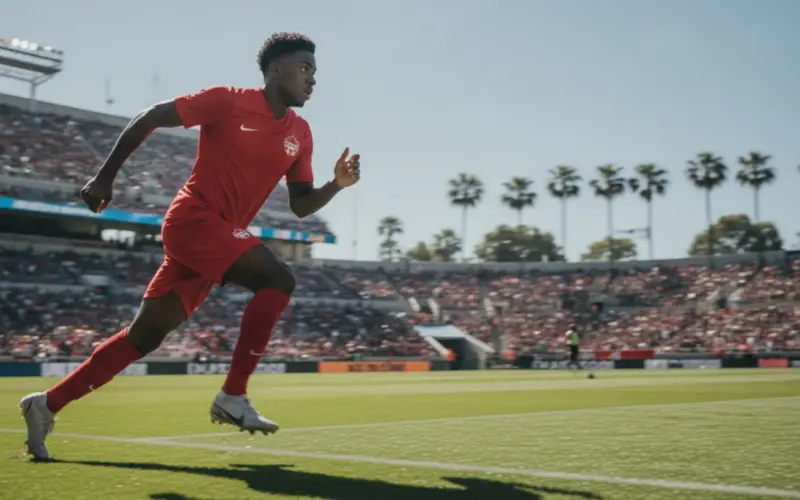
For weeks, the entire nation has been gripped by one question: Can Alphonso Davies finally heal and play? After three weeks of anxious silence, the answer is yes. Canada’s captain, their most decorated star, and arguably the fastest defender in the world, is set to make his World Cup 2026 debut. The match against South Africa will take place at SoFi Stadium in Inglewood, California, starting at 3 p.m. ET today.
The path to this moment was far from easy.
The Injury Timeline and What It Means
Davies’ recent medical history is a file that would scare any athlete. His last appearance for Canada occurred in March 2025 during the Nations League against the United States, where he suffered a ligament tear. Following that, he endured a cascade of setbacks:
- From February 22 to March 9: sidelined with a muscle fiber tear.
- From March 11 to April 2: out with a right hamstring injury.
- On May 6: injured his left hamstring during Bayern Munich’s Champions League semifinal against Paris Saint-Germain.
Three separate injury stints in just four months. For a player whose style relies entirely on explosive speed and dynamic movement down the left flank, each setback carried a genuine risk of making the situation worse. The coaching staff remembered that rushing him back in early 2025 resulted in a blown ACL. They were determined not to make that mistake twice.
Watching From the Bench While Leading the Team
The 25-year-old has not played since that late May hamstring issue, forcing him to watch Canada’s first two World Cup games from the sidelines. He did not dress for the 1-1 draw against Bosnia and Herzegovina in Toronto. He sat on the bench, watching but not playing, as his teammates dismantled Qatar 6-0 in Vancouver—the city where he made his professional debut. He also watched the Switzerland match, where coach Jesse Marsch executed a clever tactical trick: Marsch placed Davies on the bench as a decoy, knowing he wouldn’t play, to force Switzerland to waste preparation time focusing on him. Marsch later confirmed, “I listened to their news conference and they had three questions about Alphonso Davies, so they at least had to prepare for that.”
Even in street clothes, Davies was altering the opponent’s game plan. That is the level of impact Canada possesses.
Why This Match Is Different
South Africa’s path to the knockout round was built on defensive resilience. They conceded only one goal across three group matches. They are organized, hard-working, and dangerous on the counterattack. On paper, they are the exact type of team that a fully fit Alphonso Davies was designed to unlock.
At his peak, Davies is among the five best left-backs globally. His speed behind defensive lines is virtually unmanageable at the international level. His crossing, his ability to combine with Jonathan David in the final third, and his capacity to drag defenders out of position create space that Canada’s attackers—David, Tajon Buchanan, and Tani Oluwaseyi—know exactly how to exploit.
With Davies in the lineup, Canada’s left side transforms from functional to frightening.
Beyond the Pitch: A Symbol of Hope
Davies’ return carries a weight that goes beyond tactics. Born in a refugee camp in Ghana after his parents fled civil war in Liberia, he grew up in Edmonton and became a symbol of what Canadian soccer—and Canadian society—can achieve. He has carried the hopes of an entire nation for years, through injuries, uncertainty, and the humiliation of watching from the bench during his own country’s group stage.
Today, on the biggest stage his sport offers, he finally gets his moment.
Canada faces South Africa at 3 p.m. ET. Fans can watch on TSN and CTV. Davies is ready to play.