

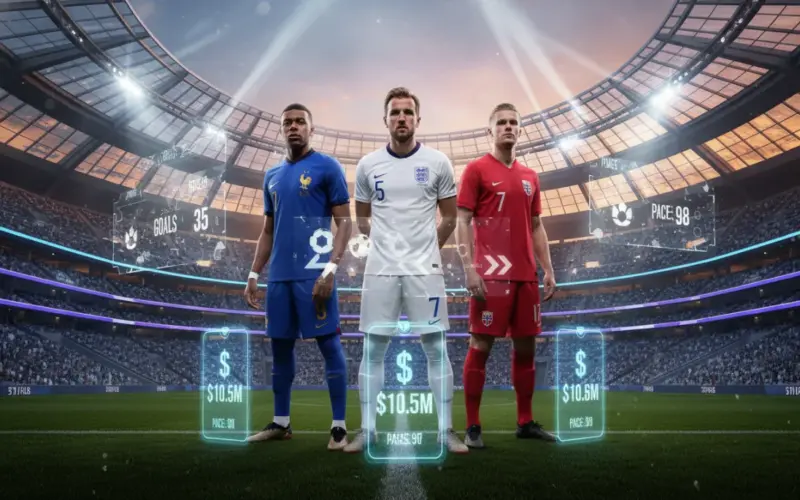
The official FIFA World Cup 2026 fantasy game has arrived with support from Aramco, giving fans a fresh way to engage with the tournament before a ball is kicked. Players will build a 15-man squad, chase points across global and regional rankings, and try to outthink millions of other managers using a mix of star power, value picks, and timely transfers.

How the Game Is Built
The format is designed around tournament football rather than a full domestic season, so every choice carries more weight. Managers must assemble a squad of 2 goalkeepers, 5 defenders, 5 midfielders, and 3 forwards within an opening budget of $100 million, and that budget rises by $5 million once the knockout rounds begin. Unlike many club fantasy games, player prices stay fixed throughout the competition, which makes the initial draft especially important.
There are also nation-based restrictions that change with the stage of the event. In the group phase, no manager can stack too many players from one country, which pushes users to look beyond the most obvious elite options. Transfers are completely unlimited before the opening match on Thursday, 11 June, and again before the Round of 32, while later stages return to standard limits. During live matchdays, users can still adjust their captaincy and use bench substitutions to improve their score.
The chip system adds another layer of planning. Five boosters are available across the tournament: Wildcard, 12th Man, Maximum Captain, Qualification Booster, and a mystery chip that will be revealed before the Round of 32. That structure rewards managers who think ahead rather than waiting until the last minute.
Where Points Come From
Scoring is tied to on-field production and a wide range of match statistics, so clean sheets and goals are only part of the story. Minutes played, assists, goals scored and conceded, cards, own goals, penalties won or given away, tackles, chances created, and shots on target all contribute to a player’s total. Bonus points also matter, especially for direct free-kick goals and for low-owned players who deliver a standout performance.
The scouting bonus is especially interesting because it rewards smart differentials. If a player selected by fewer than 5% of managers scores more than four points in a match, that choice can create separation in the overall standings. In a short tournament, those marginal gains can decide whether a team rises in the rankings or disappears into the middle of the pack.
Top Prices and Regional Depth
The market clearly reflects the tournament favorites. Premium attackers sit at the top of the price list, with Erling Haaland, Harry Kane, and Kylian Mbappe all valued at $10.5 million. Lionel Messi and Cristiano Ronaldo follow at $10 million, showing how heavily the game rewards elite finishing talent even when budgets are tight.
Defensive and goalkeeping values are lower, but the elite names still stand out. Portugal’s Nuno Mendes is the most expensive defender at $5.8 million, while the goalkeeping pool includes Brazil’s Ederson and Alisson Becker along with Spain’s David Raya and Unai Simon. That spread gives managers room to build balanced squads instead of spending nearly everything up front.
| Category | Leading Options | Price |
|---|---|---|
| Forwards | Erling Haaland, Harry Kane, Kylian Mbappe | $10.5m |
| Forwards | Lionel Messi, Cristiano Ronaldo | $10m |
| Defenders | Nuno Mendes | $5.8m |
| Goalkeepers | Ederson, Alisson Becker, David Raya, Unai Simon | Premium tier |
The pricing model also reveals how much the top nations shape the fantasy economy. Of the 25 most expensive players, 20 come from the top six countries in the FIFA/Coca-Cola Men’s World Ranking, and England and France account for five premium players each. That concentration makes the biggest football powers especially valuable, but it also creates pressure to find efficient alternatives elsewhere.
The Confederation Challenge Leaderboard increases that incentive by measuring performance through regional selections, not just individual picks. In Africa, Mohamed Salah and Omar Marmoush lead the way at $10 million and $7.8 million. In Asia, Son Heungmin and Salem Al Dawsari headline their region at $7.4 million and $7.2 million. Among the host nations in North America, Jonathan David, Raul Jimenez, and Christian Pulisic are each priced at $7 million, while Oceania’s top attacking option is New Zealand striker Chris Wood at $6.5 million.
Historical note: Kylian Mbappé won the adidas Golden Boot at FIFA World Cup Qatar 2022™. The award began as the Golden Shoe in 1982 and adopted its current name in 2010 to honor the tournament’s leading scorer, with second and third place receiving the Silver and Bronze Boots.