
A squad announcement with more than football attached
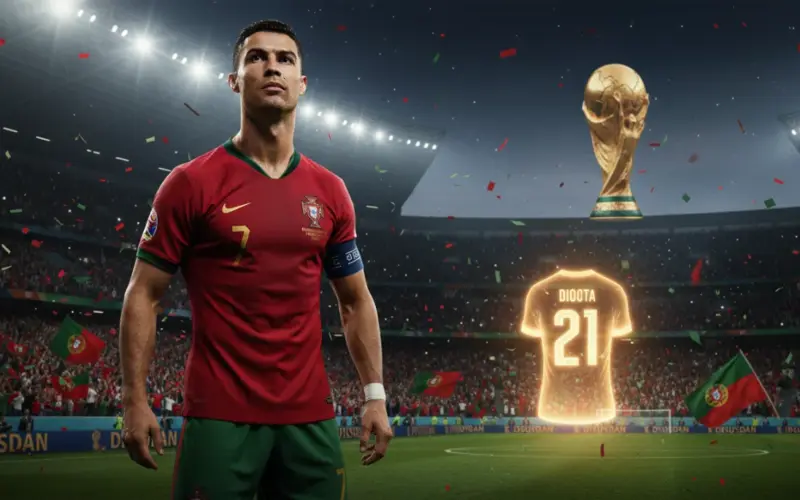
Portugal’s latest World Cup roster is about far more than selection debates and tactical balance. Roberto Martínez has unveiled a group that combines elite experience, rising talent, and a deep emotional current running through the entire camp. Cristiano Ronaldo is in the squad, ready for what could become a sixth World Cup appearance, while the memory of Diogo Jota gives the announcement a solemn and deeply human layer.
That contrast defines Portugal’s build-up. On one side is a veteran captain still chasing the biggest remaining prize in the game. On the other is a teammate remembered with affection and pain, a reminder that international football is never only about results. For Portugal, this tournament begins with ambition, but it also begins with reflection.
Ronaldo’s pursuit of a sixth tournament appearance
At 41, Cristiano Ronaldo continues to bend football’s usual expectations. He has outlasted generations of opponents, changed how elite forwards are judged, and remained central to every conversation about Portugal for nearly two decades. His selection for this squad signals that Martínez still values him as much for what he brings off the ball and inside the dressing room as for the goals he can still score.
If Ronaldo takes the field at the tournament, he will join one of the most exclusive clubs in men’s football history by appearing in six different World Cups. Lionel Messi could match that mark as well if he features for Argentina, which adds another layer to a rivalry that has already shaped an era.
Ronaldo’s resume is already stacked with records that would be difficult for any player to approach, including the most goals in men’s international football, the most appearances in men’s international football, and the distinction of being the only male player to score in five separate World Cups. Even now, his presence changes the way opponents prepare and the way Portugal imagines its attack.
Diogo Jota’s memory gives the campaign its soul
While Ronaldo naturally dominates headlines, the most touching part of Portugal’s announcement was the tribute to Diogo Jota. The former Liverpool and Portugal forward died in a car crash in Spain last year at the age of 28, leaving a loss that still echoes through the national team and beyond it.
Martínez described Jota as Portugal’s “plus one forever,” a phrase that captures both grief and unity. Portugal’s official squad limit may be 26 players, but by symbolically naming 27, the staff made clear that Jota will remain part of the group in spirit. That gesture was not ceremonial in a shallow sense; it felt personal, deliberate, and rooted in genuine affection.
For the players, that remembrance could become a source of strength. Tournaments often produce emotional fuel, and Portugal now carries one of the most powerful forms of it. Every match will unfold under the shadow of loss, but also under the light of loyalty.
Why this Portugal team looks built for a long run
Portugal’s roster stands out because it is not dependent on one type of player. Martínez has assembled a team that can control possession, stretch opponents wide, defend with authority, and change tempo quickly when space opens. That variety matters in a short tournament, where one bad matchup can end a promising run.
The squad also carries a useful mix of age profiles. Older players such as Ronaldo and Bruno Fernandes provide memory, standards, and game management, while younger options bring acceleration and fearlessness. That blend gives Portugal the chance to adapt from match to match rather than forcing one fixed identity onto every opponent.
Comparing the main areas of the squad
| Area | Key Strength | Notable Names |
|---|---|---|
| Goalkeeping | Reliability and depth | Diogo Costa, José Sá, Rui Silva, Ricardo Velho |
| Defense | Physicality and distribution | Rúben Dias, João Cancelo, Diogo Dalot, Nuno Mendes |
| Midfield | Control and creativity | Bruno Fernandes, Bernardo Silva, Vitinha, João Neves |
| Attack | Finishing and pace | Cristiano Ronaldo, Rafael Leão, João Félix, Gonçalo Ramos |
Defense, midfield, and attack all have clear identity
In goal, Diogo Costa remains the likely first choice, with José Sá and Rui Silva offering experienced support. Ricardo Velho’s inclusion as a fourth option suggests the staff wants insurance in case injuries or sudden fitness problems appear during the build-up.
The back line gives Portugal serious flexibility. Rúben Dias remains the anchor, a defender who organizes those around him and rarely loses his composure in demanding matches. João Cancelo, Diogo Dalot, and Nuno Mendes offer something different: they can push high, create overloads, and make Portugal feel almost like an extra attacking unit when they step forward.
Midfield may be the area where Portugal looks most complete. Bruno Fernandes can unlock compact defenses with passing and movement, Bernardo Silva can keep the ball under pressure, and Vitinha along with João Neves adds technical precision and energy. Rúben Neves and Samú Costa give Martínez other options if a match requires more physical control or defensive discipline.
Up front, Portugal can choose from several different kinds of threat. Ronaldo remains the natural focal point, but Gonçalo Ramos offers a more traditional central striker profile, Rafael Leão adds direct dribbling and speed, and Pedro Neto and Francisco Conceição can attack wide spaces with urgency. João Félix and Gonçalo Guedes provide additional creativity and versatility, while Francisco Trincão brings another layer of craft.
Preparation matches should reveal the preferred formula
Portugal has already lined up a busy lead-in to the tournament. The team is scheduled to meet in early June, then test itself against Chile on June 6 and Nigeria on June 10 before traveling to the United States on June 12. The opening group match follows on June 17 against Congo in Houston.
Those matches will matter more than simple scorelines. Martínez will use them to settle on rhythm, refine his starting XI, and determine which combinations work best under pressure. The staff’s challenge is not finding quality; it is choosing the right balance of tempo, protection, and attacking intent.
Group K offers no easy path
Portugal’s group includes Congo, Uzbekistan, and Colombia, a mix that forces different kinds of preparation. Congo may bring athletic intensity, Uzbekistan can be organized and difficult to break down, and Colombia adds a higher technical level and the possibility of a very open game. None of those opponents should be treated lightly.
That is part of what makes tournament football unforgiving. A strong squad can still struggle if it starts slowly or misreads the rhythm of a match. Portugal’s advantage is that it has players who have seen all of this before. Ronaldo has lived through every kind of World Cup pressure, and several of his teammates have spent years competing in major European nights that demand similar poise.
Martínez keeps expectations ambitious but realistic
Roberto Martínez has avoided making loud promises, even with a squad many supporters believe can go all the way. He has noted that the title of favorite usually belongs to teams that have already won the World Cup, and Portugal has not yet done that. Still, he clearly believes this group belongs in the conversation.
The reason is easy to see. Portugal recently won the 2025 Nations League by defeating Germany in the semifinal and Spain in the final, proof that this squad can handle elite opposition in tense moments. That success does not guarantee anything in a World Cup, but it does provide evidence that the team can rise to the level of the best.
What could decide Portugal’s ceiling
Portugal’s chances may come down to whether the team can keep its structure while allowing its stars to express themselves. Ronaldo does not need to dominate every phase to remain valuable, but the team must ensure he receives service in areas where his finishing remains decisive. At the same time, the midfield cannot lose its rhythm by overfeeding one channel of attack.
If Martínez gets the balance right, Portugal could be one of the most dangerous teams in the competition. If the balance slips, even the deepest squad can become predictable. That is why the coming weeks matter so much: they will show whether this is simply a talented roster or a genuine title contender.
A campaign driven by memory, belief, and unfinished business
Portugal enters the World Cup with a rare combination of motivation and quality. Ronaldo is chasing a historic milestone, Martínez is chasing a first world title for the country, and the squad is carrying Diogo Jota’s memory as part of its emotional core. Those three threads make this more than a routine tournament story.
There is still a long road ahead, but Portugal has the talent to travel it with purpose. The question is no longer whether this team has enough names to compete. The question is whether it can turn those names into something lasting. If it does, this World Cup could become one of the defining chapters in Portuguese football history.