

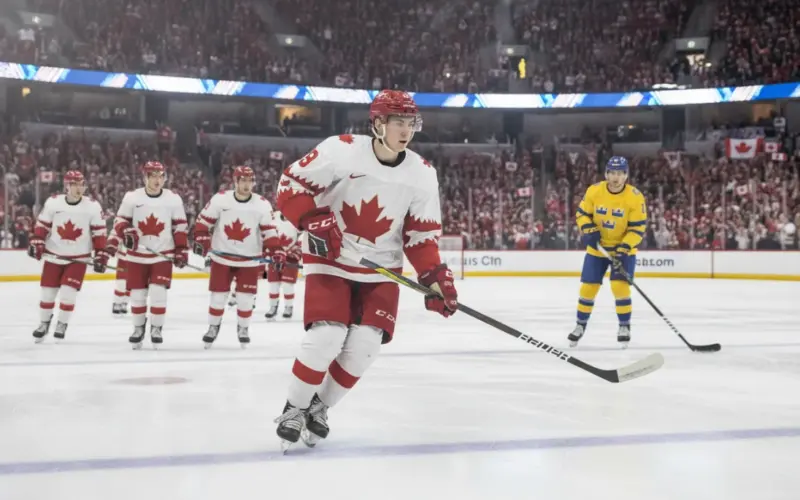
Canada has already locked up a semifinal berth at the Hlinka Gretzky Cup, but the most important hockey is still ahead. After strong wins over Switzerland and Slovakia, the host team now closes Group A against Sweden before the tournament shifts into knockout play.
The final preliminary game is scheduled for Wednesday, August 5, at Rogers Place in Edmonton. Puck drop is set for 5 p.m. Mountain Time and 7 p.m. Eastern Time, and Canada will enter the matchup knowing first place in the group is already secured.
A quick path to the top of Group A
Canada made a fast and forceful start to the tournament with a 7-3 win over Switzerland. The Canadian offense broke the game open early, scoring five times in the opening period and finishing with a commanding 48-25 edge in shots.
Liam Pue scored twice in that opener, while Brock England, Camryn Warren, Ryerson Edgar, and Benjamin Veitch also scored. England later added a short-handed goal in the third period, which completed his two-goal night and highlighted Canada’s ability to score in a variety of game situations.
The second game was even more one-sided. Canada defeated Slovakia 6-1 and controlled the pace from start to finish. Kayden Stroeder scored twice, while Landon DuPont, Warren, Edgar, and Pue also found the net. Canada generated 48 shots again and allowed only 13, and goaltender Leif Oaten turned aside 12 of the 13 attempts he faced.
That kind of production points to a roster with real depth. Through two games, Pue, Edgar, and Warren had each collected four points, which put them near the top of the tournament scoring race. Pue led Canada in goals, and Maddox Schultz had already posted four assists, showing how many different players can drive the offense.
The early results have also shown that Canada is not leaning on one line or one standout prospect to carry the load. Goals have come from multiple forwards, and the defense has helped sustain pressure by joining the attack and keeping opponents pinned back. That balance can matter even more once the tournament turns into a single-elimination race.
Why Sweden still matters
Even though Canada no longer needs Wednesday’s result to advance, the meeting with Sweden still carries value. It is a final tune-up before the pressure rises, and it will give Canada one more chance to sharpen its pace, structure, and special teams against a capable opponent.
Sweden has not had a perfect start, but it has remained in the mix. The Swedes opened with a 4-3 win over Slovakia before falling 7-6 to Switzerland in a high-scoring contest. That leaves them needing a strong finish against Canada if they want to strengthen their semifinal hopes.
Canada and Sweden already met in pre-tournament action, and Canada won that game 3-1. The group-stage meeting should offer a more meaningful read on both teams, though, because this one comes with real tournament pressure behind it.
Sweden has shown that it can score. Dorian Eklund Aspe entered the game with four points, while Oliver Sundberg and Milan Sundstrom had each scored twice through two appearances. That kind of offensive talent means Canada will need to stay organized even if the standings have softened the urgency.
For Canada, the game offers a chance to keep the rhythm going without the added burden of needing a result. Head coach Ryan Oulahen can also use the matchup to test combinations, manage minutes, and prepare his group for the faster, more physical hockey that usually defines the medal round. Oulahen was part of Canada’s staff when the country won this event in Edmonton in 2024, and he now leads the team as head coach.
Group standings and what they mean
Canada’s place at the top of Group A changes the immediate stakes but not the larger mission. By finishing first, Canada will face the second-place team from Group B in Friday’s semifinal. The other semifinal will pair the Group B winner with the second-place team from Group A.
The two semifinal winners move on to the gold-medal game on Saturday, while the losing teams meet for bronze. That structure makes every shift in the final round important, because one bad period can remove a team from the championship path entirely.
| Team | Preliminary record | Standing impact |
|---|---|---|
| Canada | 2-0 | Clinched first place in Group A |
| Switzerland | One win through early play | In position to finish near the top of Group A |
| Sweden | 1-1 | Still chasing a semifinal spot |
| Slovakia | 0-2 | Needs a turnaround to stay alive |
The final opponent is still unclear for Canada because Group B has not fully settled. The United States was in first place after two games, while Czechia and Finland were tied on three points and Germany had yet to earn any. That means Canada will have to wait until the rest of the preliminary schedule is complete before knowing its semifinal matchup.
The uncertainty does not change the basic truth: the knockout round will be a major step up in pressure. Canada experienced that reality in 2025, when it went through the preliminary round unbeaten before losing 4-3 to the United States in a semifinal shootout. Canada then recovered to beat Finland for bronze, but the defeat ended its title run.
A familiar standard for Canadian hockey
The expectations around Canada at this tournament are tied to history as much as to current form. Since the event began in 1991, Canada has won 25 of the 34 summer under-18 gold medals awarded. The program has also put together dominant stretches, including seven straight titles from 1996 to 2002 and eight in a row from 2008 to 2015.
The setting adds another layer. Canada has already won gold in each of the three previous Alberta-hosted editions: Edmonton and Red Deer in 2018, Red Deer in 2022, and Edmonton in 2024. In the most recent local edition, Canada beat Czechia 2-1 at Rogers Place to claim the championship.
That history creates a clear target for this group. Another title would give Canada its 26th summer under-18 gold medal and keep its Alberta record perfect. More immediately, it would extend a trend that has often made the country the standard-bearer at this level.
The Hlinka Gretzky Cup also serves as an early show for players headed toward major junior and NHL draft attention. Because the event brings together top under-18 talent from eight strong hockey nations before club conflicts limit availability, it gives scouts and fans a useful first look at players who may soon become much bigger names.
DuPont has drawn plenty of attention, but Canada’s opening games have also pushed Pue, Edgar, Warren, Schultz, and Stroeder into the spotlight. The semifinal will give those players their first real elimination-game experience on this stage, which is often where prospects begin to separate themselves from the field.
The games that will define the week
Canada’s final preliminary game against Sweden matters, but the biggest audience interest will likely arrive during the medal round. The semifinals are set for Friday, August 7, and the bronze- and gold-medal games are scheduled for Saturday, August 8. The championship game is slated to begin at 5 p.m. Mountain Time.
TSN and RDS are carrying the preliminary games, semifinals, and medal games from Rogers Place, which means the tournament will stay in the spotlight through the finish. Canada has already handled the first part of the assignment by securing the top seed in its group. The remaining challenge is turning that strong start into two more wins.
If Canada can carry its scoring depth, home-ice comfort, and defensive structure into the knockout round, it will put itself in position to play for gold again. The preliminary round has shown that this roster has enough skill to contend. The medal round will show whether it can manage the stress that comes with trying to finish the job at home.