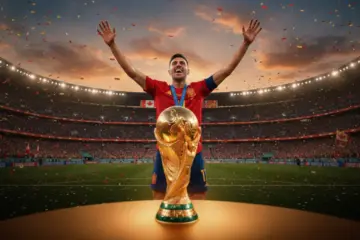


A new generation has turned one of soccer’s most famous records into a live race again. Miroslav Klose’s long-standing standard of 16 World Cup goals now has company, and the chase behind him has become as compelling as the record itself.
With the tournament stage set in the United States, Mexico, and Canada, the top of the scoring list carries more drama than it has in years. Lionel Messi has matched Klose, Kylian Mbappé is close enough to make every finish feel significant, and the sport’s most iconic names still shape the conversation around the World Cup’s greatest scorers.
The Names At The Top
The all-time leaderboard is a compact history of the tournament itself. It rewards longevity, tournament brilliance, and the rare ability to score under the highest pressure.
- Miroslav Klose and Lionel Messi are tied on 16 goals, the benchmark every modern striker studies.
- Ronaldo Nazário sits just behind on 15, a reminder of how dominant he was across multiple editions.
- Gerd Müller and Kylian Mbappé share fourth place on 14, linking a classic finisher with a current star.
- Just Fontaine, Pelé, and other legends remain firmly in the upper tier, where the numbers become harder to separate and easier to admire.
Once a player moves into double digits at the World Cup, the list starts to narrow quickly. From there, every goal changes the historical picture, and every tournament appearance becomes a chance to move up a level.
Why Klose Still Stands Out
Klose’s record feels especially sturdy because it was built without flash. He was not known for spectacular strikes or endless highlight reels. He was known for arriving in the right place at the right time, over and over again.
The German forward scored his 16 goals across four World Cups, and he did it with a level of consistency that made him easy to overlook in the moment and impossible to ignore in retrospect. His debut hat-trick against Saudi Arabia in 2002 announced the pattern early, and his final tournament in 2014 ended with the title that completed his case as one of the competition’s defining scorers.
Messi’s Late Run Changed The Story
For years, Messi’s World Cup legacy was judged through a different lens. The brilliance was never in doubt, but the goals did not always come in a straight line, and the title remained out of reach until Qatar.
That changed with Argentina’s run to the 2022 trophy, when Messi delivered a complete tournament and pushed his World Cup total into the highest tier. Now that he has matched Klose, his next goal carries historical weight rather than just match value. It is no longer about catching up. It is about moving into territory no one has owned alone for long.
Messi’s climb is also notable because it spans so many tournaments. He has had to score across different versions of the Argentina team, different stages of his own career, and different tactical eras. That makes his 16 feel less like a single burst and more like a long, carefully built arc.
The Pursuit Behind Them Is Real
If Klose and Messi define the summit, Mbappé defines the pressure below it. The French forward has moved quickly enough to make the record feel vulnerable, and his age gives him a runway almost none of the players above him enjoyed.
He already has a title, a final hat-trick, and a scoring rate that suggests he can keep climbing as long as France remain in contention. The interesting part is not just that Mbappé is chasing the record. It is that he is doing so while still writing the middle chapters of his career.
That matters because World Cup scoring is rarely about talent alone. It also depends on team quality, match volume, and the ability to stay relevant across multiple cycles. Mbappé checks all of those boxes, which is why his place on this list feels more like a beginning than an endpoint.
The Most Dangerous Records Are The Ones People Forget
Just Fontaine’s 13-goal eruption in 1958 remains one of the most extraordinary one-tournament feats in football history. He did not spread his total across years. He produced it all at once, in a single summer, in only six matches.
That kind of peak is hard to imagine repeating. Even in an era of more matches and more attacking football, the concentration of goals required to challenge Fontaine has rarely appeared. The all-time list may be open, but the single-tournament mark still sits in a different category.
Players Who Still Have A Chance To Move Up
- Cristiano Ronaldo remains in the conversation with eight World Cup goals, even as he enters the closing stretch of his international career.
- Harry Kane has enough scoring ability to climb quickly if England produce a deep run.
- Neymar, when available and in form, can still add enough goals to change his place on the chart.
These totals are not just trivia. They show how narrow the gap becomes once a player reaches elite World Cup territory. One strong tournament can alter a career’s historical position in a matter of weeks.
What Makes This Race So Compelling Now
The fascination comes from contrast. Klose represents efficiency, Messi represents longevity and late mastery, Ronaldo Nazário represents peak brilliance, and Mbappé represents the possibility of a future record that may arrive before anyone expected it.
That combination is rare. Most records sit still long enough to become museum pieces. This one feels alive because the players near the top are still active, still dangerous, and still capable of changing the order with a single finish.
The result is a leaderboard that functions like an ongoing match rather than a closed chapter. Every World Cup goal now carries two meanings: one for the scoreboard on the day, and one for the place it changes in football history.